Signs That Help People Find the Right Place First Time
Property signage is often the first thing a tenant, visitor or contractor sees when they arrive. In Bloemfontein, Mangaung and the surrounding towns, that usually means a mix of entrance boards, unit numbers, directional signs, notice boards and window markings that can be read from a moving vehicle or from across a courtyard. When the layout is clear, people spend less time asking for directions and the site feels easier to use.
For rental stock, estates and managed facilities, the goal is practical. A good system reduces confusion at access points, improves safety and makes the property look cared for even when the buildings are busy. In windy or dusty areas, and on sites exposed to strong Free State sun, the choice of material and fixing method matters just as much as the wording.
Central Signs works from Hamilton in Bloemfontein and supplies property signage across Bloemfontein, Botshabelo, Thaba Nchu, Welkom and Kroonstad. We also work with site teams who need a quick turnaround after tenant changeovers, renovations or new development phases.
Typical Property Signage Set-ups for Developments and Estates
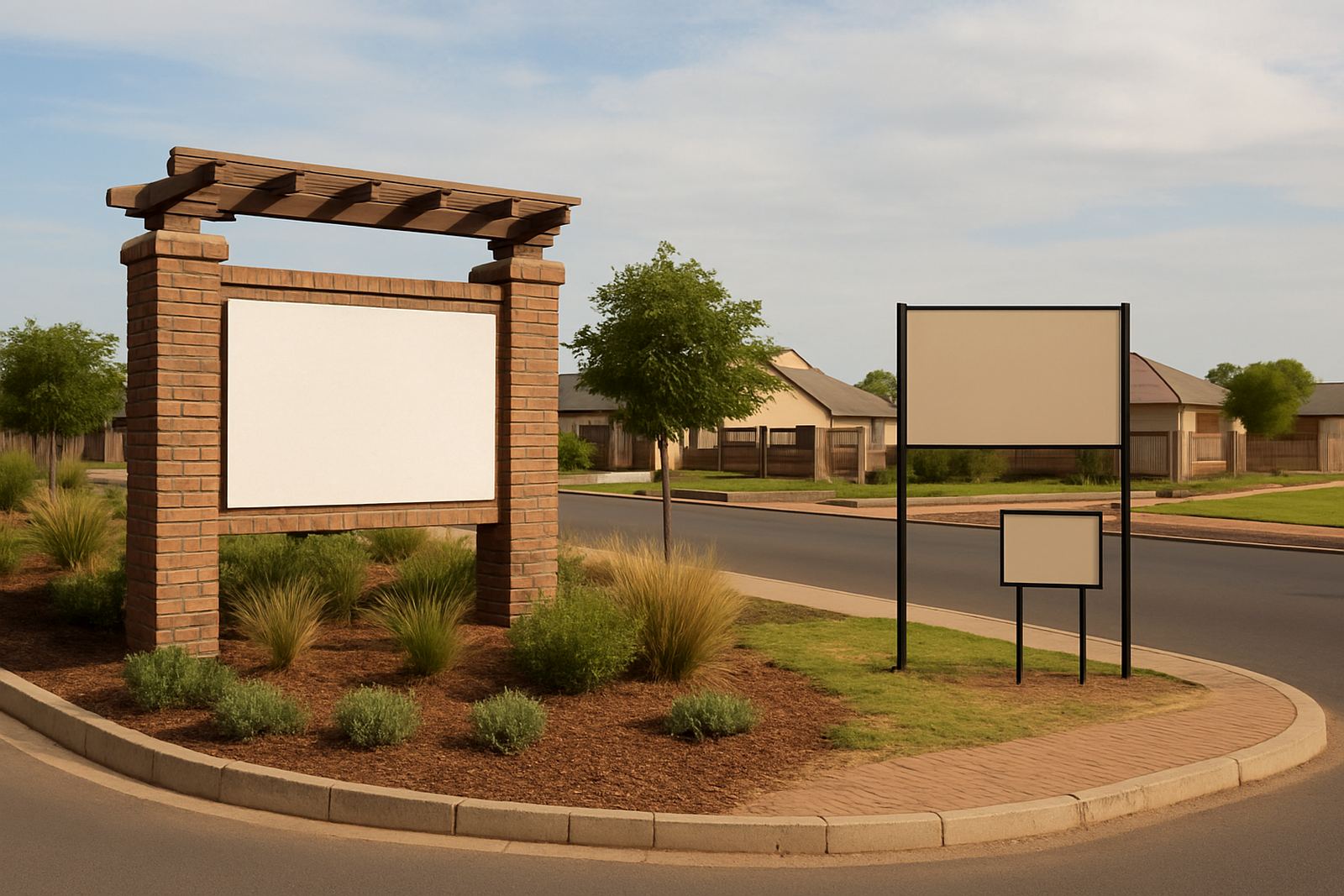
Every site has its own traffic flow, but most property sign packages start with a core set of signs that can be added to as the development grows. For a new estate or commercial park, that may include an entrance sign, directional blades, parking control boards, unit identification, wall-mounted safety notices and printed decals for glass doors or reception areas.
- Entrance boards for street-facing visibility
- Directional signs for driveways, stairs and corridors
- Unit, erf and suite numbering
- No parking, access control and safety notices
- Window graphics for tenancy and operating hours
- Floor markers for routes, queue points or restricted zones
On industrial and logistics sites, the set may also include load bay markings, warning labels, forklift routes and reflective numbering for after-hours access. In estates, neat wayfinding helps guests, couriers and service providers move through the site without slowing residents down. For facilities teams, that means fewer repeated instructions and fewer mistakes at gates or in parking areas.
Planning the Layout Before Anything Gets Printed
The best property signage starts with a site survey. We look at how vehicles enter, where pedestrians cross, where visibility is blocked and which signs need to be read from a distance. A sign that works in a quiet courtyard may fail at a busy gate if it is too small or placed too high. Likewise, a board facing the afternoon sun may bleach out faster than expected if the artwork or material is chosen badly.
A proper layout plan helps decide the size, height and order of each sign. It also helps keep the site looking organised rather than crowded. We usually recommend keeping the main name board, directional signs and safety notices in a consistent style so the property looks like one system, not a patchwork of separate jobs. It also helps to decide early whether the signs must be fixed to walls, posts, gates, glass or floors.
For developments still under construction, phased planning is useful. You can start with temporary boards and then move to permanent signage once the final unit names, access roads and parking rules are confirmed. That avoids reprints and saves money later.
Materials and Finishes That Suit Free State Conditions
Property signage in the Free State has to stand up to hard sun, dust and occasional heavy wind. In some parts of Mangaung and the surrounding towns, that means choosing materials that will not warp, peel or fade too quickly. For boards, we often use rigid panels with printed faces, laminated vinyl and cut lettering depending on the application. For glass and smooth wall surfaces, decals and printed films are usually neater and easier to update.
- Rigid boards for entrances and durable outdoor use
- Self-adhesive vinyl for doors, glass and windows
- Reflective or high-contrast graphics for visibility
- Laminated prints for longer outdoor life
- Floor graphics for controlled indoor routes
If the site has load-shedding risks, any sign that needs lighting should still be legible in low light, so colour contrast and size become more important. On coastal projects humidity can affect some adhesives, but around Bloemfontein the main issue is UV and heat, so material choice should be based on sun exposure and how often the sign will be cleaned. For a property with regular maintenance visits, we can also recommend finishes that are easier to wipe down without marking.
Common Mistakes That Cost More Than the Sign Itself
One of the most common mistakes is making the main sign too small for the road speed or viewing distance. Another is using too many fonts, colours or sign styles, which makes the site look untidy and confuses visitors. It is also easy to miss the practical details, such as where a driver will first see the board, whether the sign is blocked by trees or if security lighting creates glare at night.
Property managers sometimes order signs before checking the final wording with the facilities team or body corporate. That can lead to reprints for unit numbers, parking rules or access instructions. A missing comma or a wrong suite number may seem minor, but on a busy site it sends people to the wrong place and creates complaints. We also see signs installed without enough fixing points, which is a problem in strong wind or on walls that are not perfectly flat.
Another issue is using temporary printing where a longer-life solution would have been better. If the site is permanent and the rules will stay the same, it usually pays to choose a stronger board or a better laminated finish from the start.
Budget Ranges for Property Signage Projects
Property signage budgets can be modest or substantial depending on the number of signs, the size of the boards and the level of finish. A simple set of door decals, unit numbers and a few directional signs may start from around R2 500 to R6 000. A more complete package for a small estate or business park often falls between R8 000 and R25 000.
Larger developments, multi-building facilities and sites needing custom fabricated entrance boards can run from about R30 000 upwards, especially if there are multiple posts, illuminated elements, anti-vandal fittings or repeated sections for phases one to three. Installation, site access and working hours also affect the total. If the team must work around live operations, security rules or after-hours access, that adds time and planning.
We usually advise clients to split the work into essentials first, then add secondary signs once the site is functioning. That keeps the opening budget under control while still making the property easy to navigate from day one.
How Central Signs Handles Signage for Active Sites
For property signage, the process needs to be orderly because many people are involved, from developers and managing agents to security teams and contractors. Central Signs starts with a site survey and artwork setup, then confirms sizes, materials and fixing points before production. If a logo needs redrawing or a colour needs matching across several signs, that is done before anything goes to print. That saves time and avoids mismatched signs across the site.
Our team in Bloemfontein includes production, design, fabrication, installation and vehicle graphics support, so larger property projects can be handled in one place. That matters when a development needs entrance boards, wayfinding, notice boards and window graphics at the same time. It also helps when a tenant changes and the old branding must be removed cleanly before the new signs go up.
For enquiries, clients use the form on our contact page. From there we can scope the work, advise on the right mix of boards and graphics, and plan a rollout that suits the site and the budget.