Why frosting works so well in Free State offices
In Bloemfontein and across Mangaung, a lot of office spaces use glass to keep rooms bright, but that also means people can see straight into boardrooms, consult areas and reception spaces. Frosting solves that in a simple way. It cuts direct visibility while still letting in natural light, which matters in buildings where you want a bright interior without making staff feel on display.
It is also practical for the Free State climate. Strong sun can make clear glass feel harsh in the afternoon, while frosted film softens glare a bit and keeps the space more comfortable. In shared offices, medical rooms, training spaces and municipal waiting areas, that extra privacy can help people feel calmer and more at ease.
We often suggest frosting for companies that need a neat, professional look without overloading the glass. A plain band can be enough, or you can build in cut-out logos, text or patterning that ties the room to the rest of the branch. The trick is to match the pattern to the space, not just to choose something decorative for the sake of it.
Pattern styles that suit meeting rooms and reception areas
Office frosting patterns range from very simple to highly branded. The best choice depends on how much privacy you want, how formal the room is, and how much attention you want the glass to draw. A boardroom in a law office will usually need something cleaner than a creative agency or training centre.
Some of the most useful options are:
- Full frosted panels: Best for privacy on lower glass panels, storerooms, treatment rooms and places where people should not be visible.
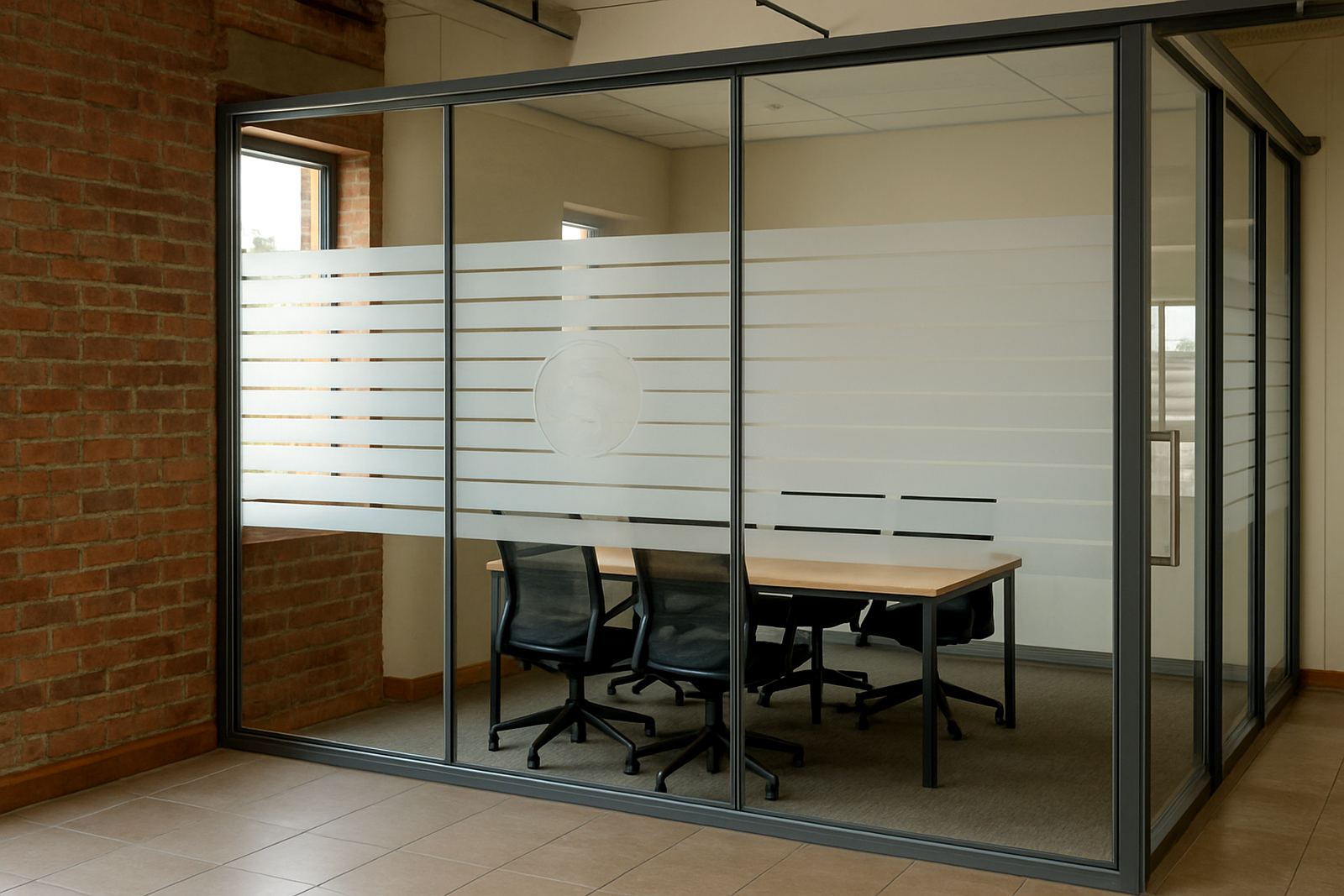
- Privacy bands: A band across the middle of the glass gives seated privacy while still leaving the top and bottom open for light and visibility.
- Gradient frosting: A soft fade from clear to frosted can look refined in reception areas and meeting rooms.
- Cut logo sections: A company mark or name can be removed from the frosting so the logo sits crisply on the glass.
- Striped or geometric patterns: Useful for modern offices where you want movement and interest without using too much branding.
For many Bloemfontein businesses, the middle band is the most practical. It stops people from looking in at seated height, and it gives enough space for a logo, service line or room name. If the glass faces a public passage, full frosting on the lower section is often the better choice.
How to balance privacy and light in South African offices
Good frosting is about balance. Too little and the room still feels exposed. Too much and you lose the benefit of the glass in the first place. That balance is important in offices where staff spend long hours inside, especially during hot summer afternoons when glare becomes a real issue.
When we plan frosting for a client, we look at where people stand, where they sit, and what can be seen from the corridor or waiting area. A glass wall that faces the entrance may need a different treatment from a side office used only by staff. If the room is used for confidential work, a stronger frosted area is usually needed at eye level.
There is also the matter of cleaning and long term use. In busy offices, fingerprints show up quickly on clear glass, while frosting hides some of the everyday marks. Good quality film can handle regular wiping, but it still needs a proper installation so the edges stay neat and do not start lifting near the corners.
Useful points to check before choosing a pattern:
- Who needs privacy and from which angle
- How much daylight the room must keep
- Whether the glass is single or double sided
- How the pattern will align with doors, handles and framing
- Whether the finish must match other signs in the building
Branded frosting for meeting rooms and shared spaces
Branded frosting is a good choice when you want the glass to do more than block views. It can carry a logo, department name, room number or a simple line of text that helps visitors find their way. In a shared office, that can reduce confusion and make the space feel more organised.
For example, a meeting room at a Bloemfontein professional services office might use a frosted band with the company name repeated along the length of the glass. A training room could use a lighter pattern with room labels on each panel. In a customer-facing office, the logo can sit in the centre of the glass at eye level, with frosted stripes above and below for a tidy finish.
Branded frosting works best when it is not overcrowded. One clear message is usually stronger than several competing graphics. Keep the wording short, make sure the logo is correctly redrawn if needed, and allow enough clear space so the pattern still looks deliberate from a few metres away.
Common uses include:
- Boardroom names and room numbers
- Reception screen panels
- Consultation room doors
- Tenant branding in shared offices
- Directional marks on glass passages
What to consider before installation day
Glass frosting is only as good as the preparation behind it. Before installation, the glass must be measured properly and checked for chips, old adhesive, paint or silicone. If the panel is not clean and level, the film can show bubbles or lift at the edges. On older buildings in Bloemfontein, that prep stage matters a lot because the glass and framing are often not perfectly uniform.
It also helps to think about how the building is used during the day. If a meeting room is booked back to back, the frosting needs to be installed where it will not clash with handles, hinges or opening sections. In windy areas or in entrances with strong sun, the edge finish needs to be neat and firm, otherwise the film can wear faster than expected.
Our team looks at the site first, then plans the artwork and fitment around the glass size and the intended use. Lerato and the production team check the final layout, while Johan handles the installation side so the finish lines up properly on site. It sounds simple, but that attention to detail saves a lot of trouble later on.
Before fitting, ask these practical questions:
- Is the glass clear, tinted or patterned already?
- Will the frosting need to cover doors as well as fixed panels?
- Are there internal blinds or decals that need to stay visible?
- Will the office still be occupied during fitment?
- Does the glass need a temporary or long term finish?
A Bloemfontein example: privacy for a busy client-facing office
A good local example is a client-facing office in central Bloemfontein that needed more privacy in its meeting room without making the space feel dark. The glass wall looked neat, but visitors walking past could see too much of what was happening inside, and staff were getting distracted by movement in the corridor.
The solution was a frosted privacy band across the middle section, with the company name cut cleanly through the film. The lower section gave seated privacy, the logo gave the room identity, and the clear top section kept daylight moving through the office. It changed the room immediately, without needing heavy blinds or solid partitions.
That kind of result is why frosting is popular for businesses across Mangaung, Botshabelo, Thaba Nchu, Welkom and Kroonstad. It works in small offices and larger branches alike, and it can be extended later if the company moves into more glass fronts or adds new rooms. When the layout is planned properly, one design family can carry through the whole site.