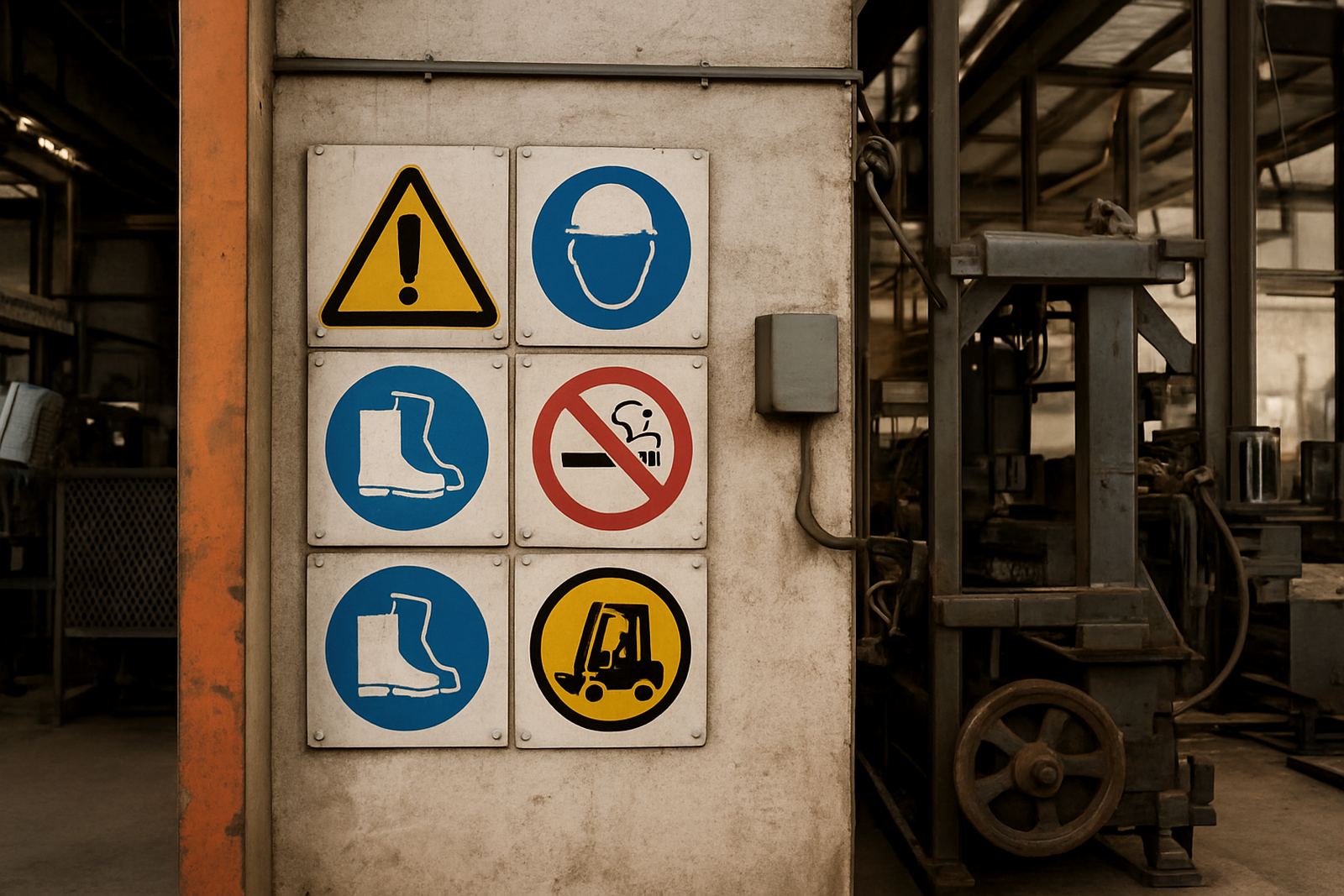
Clear warnings for busy work spaces
Safety signs are there to reduce confusion, mark hazards and show people exactly what to do in an emergency. We make signs for entrances, walkways, machine areas, loading bays, fire points, chemical stores, stairwells, parking areas and visitor routes. The right sign can prevent a costly mistake, especially where staff rotate often or contractors only spend a few hours on site.
Common uses include prohibition signs, mandatory PPE signs, hazard warnings, fire equipment markers, emergency exit signs, assembly point boards and site notices. We also supply floor markings and wall graphics for traffic flow, forklift lanes and restricted areas. In a busy warehouse or school hall, visibility matters as much as wording.
- Factories and production lines
- Warehouses and distribution centres
- Schools, colleges and public buildings
- Construction sites and contractor access points
Materials and finishes that suit the job
Different settings need different materials. For indoor use we often supply self-adhesive vinyl on rigid board, or laminated decals for smooth walls, doors and panels. For outdoor areas and rougher handling, aluminium composite, rigid PVC and tough laminated graphics work well. In Bloemfontein’s dry heat and windy conditions, the fixing method matters just as much as the print, so we match the substrate to the surface and the site conditions.
For low light areas and emergency routes, photoluminescent material is a practical choice. It absorbs light during the day and gives off a glow when the power fails. If a sign needs to stay visible at night, reflective film or internal lighting can be added depending on the location. We keep the layout simple, because a sign should be read quickly from a distance, not studied like a poster.
- Vinyl decals for doors, windows and equipment
- Rigid boards for walls, gates and posts
- Floor graphics with slip-resistant overlaminate
- Reflective or photoluminescent options for low light areas
Sizes, symbols and wording that fit the space
Safety signs are only useful if they can be seen from the right distance. We supply standard A sizes, custom cut boards and larger format signs for gates, yards and high walls. A small plant room may only need an A4 or A3 sign, while a warehouse aisle or site entrance may need a board sized 600 x 900 mm or larger. We can also set out a full sign schedule for a building so the same language and symbol style is used throughout.
When you order, check the wording, symbol and any mandatory instruction. If the sign must be bilingual, or if a site has visitors who need clearer wording, we can adjust the layout. We also redraw logos or mark-up diagrams where needed, though for safety signs the main aim is always legibility first. A cluttered sign is a weak sign, no matter how neat it looks.
- Standard sizes from A4, A3, A2 and A1
- Custom boards for gates, yards and machine areas
- Bilingual wording available on request
- Simple pictograms for quick recognition
Where safety signs work best in daily operations
These signs suit places where people move fast and need instructions without delay. Factories use them at machinery, chemical stores and access control points. Warehouses rely on them for stacking limits, forklift movement and pedestrian crossings. Schools need clear no-entry notices, fire routes and assembly points, while public buildings often need direction signs, restricted area notices and basic hazard warnings.
For outdoor sites, we recommend materials and fixings that can handle sun, dust and occasional rain. In the Free State, dust buildup can dull a sign faster than people expect, so a smooth laminated finish is usually easier to clean. On coastal jobs we would look harder at corrosion resistance, but in this region the main concerns are UV exposure, wind and surface prep. A sign mounted on a dusty wall with weak adhesive will fail early, no matter how good the print is.
- Indoor corridors, halls and staircases
- Outdoor gates, fences and loading areas
- High traffic zones with staff and visitors
- Temporary worksites and contractor areas
Installation, power and site requirements
Many safety signs do not need power at all. Wall and door signs are fixed with screws, strong adhesive or stand-off fittings depending on the surface. Floor graphics need clean, dry and properly prepared floors before application. Where a sign is illuminated or needs a light source, we check the power point location, switching arrangement and mounting height before production starts.
If the site has gas stores, flammable goods or plant rooms, placement must be planned carefully so signs stay visible and are not blocked by pipes, valves or stacked stock. We can work from a site survey and recommend the best fixing method for brick, painted steel, plasterboard, glass or concrete. It saves time later and helps avoid peeling, vibration damage or poor sight lines.
- No power needed for standard reflective, printed or engraved signs
- Photoluminescent signs need regular exposure to light
- Illuminated signs need a safe power feed and access for maintenance
- Floor signs need a clean, dry surface before fitting
Keeping signs readable and up to date
Safety signs work best when they stay clean and current. Dust, grease and sun fade can make even a good sign hard to read. A quick wipe with a soft cloth and mild cleaner is usually enough for indoor signs. For outdoor boards, check the fixings every few months, especially after strong wind or building work nearby. If a sign gets scuffed by trolleys, forklifts or equipment, it is often better to replace it than keep patching it up.
When procedures change, the signage should change too. New access routes, new machine layouts, changed fire exits or revised PPE rules all need updated signs. We also handle refurbishment, debranding and replacement runs when a site needs a fresh batch of matching signs. That keeps the whole property consistent, which is important for visitor control and staff training.
- Clean with mild soap and water
- Check fixings after storms or maintenance work
- Replace faded or damaged signs promptly
- Update signs when the layout or rules change
Key facts
| Product type | Workplace safety signs for indoor and outdoor use |
|---|---|
| Common sizes | A4, A3, A2, A1 and custom cut boards |
| Materials | Self-adhesive vinyl, laminated vinyl, rigid PVC, aluminium composite, reflective film, photoluminescent film |
| Mounting options | Adhesive, screws, stand-off fittings, frames and floor application |
| Typical use areas | Factories, warehouses, schools, sites, public buildings, parking areas and plant rooms |
| Service area | Bloemfontein, Mangaung, Botshabelo, Thaba Nchu, Welkom, Kroonstad, Brandfort and Winburg |