Why school walls should do more than look neat
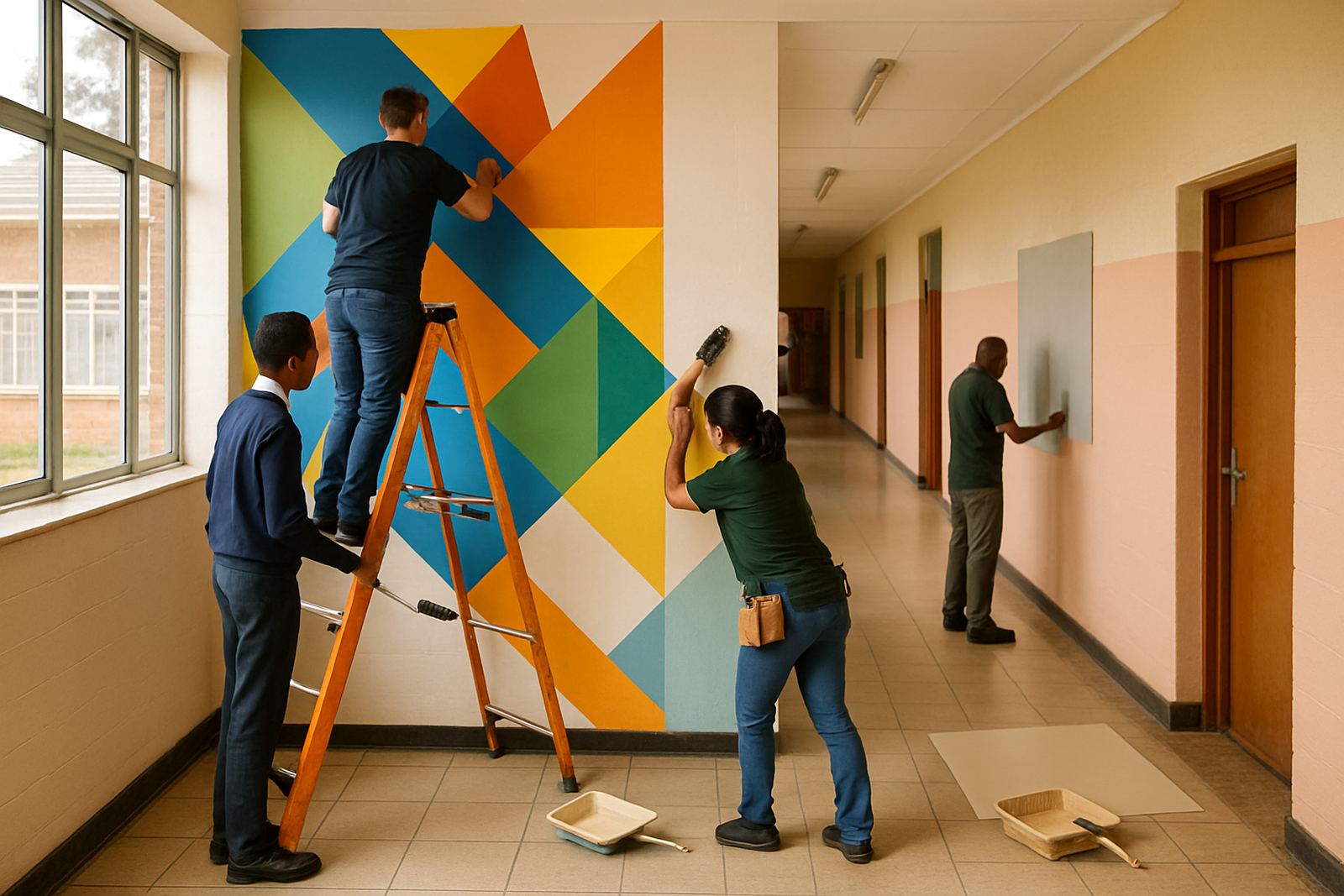
In a school, every surface gets used. Passages carry learners to class, halls host assemblies and walls are seen all day by pupils, teachers and visitors. That makes wall graphics a sensible investment, not just a decorative one. They can remind children of values, support literacy and numeracy, and make it easier to find the library, office or ablution block without asking for directions every few minutes.
Schools in Bloemfontein, Botshabelo and Thaba Nchu often deal with busy corridors, strong sunlight through windows and a lot of dust from the street or sports field. A good wall graphic needs to handle that kind of daily wear. It should be easy to read from a distance, fit the wall properly and use colours that still work in bright light. A faded message or cluttered layout quickly loses its purpose.
Learning prompts that stay visible every day
Wall graphics work well when they support what learners already see in class. A maths wall can show number lines, multiplication tables or shapes. A language wall can hold common words, phonics cues or sentence starters. In younger grades, pictures and simple labels help learners connect words to objects. In older grades, timelines, subject reminders and study tips can keep useful information in view without taking up teaching time.
These prompts are not meant to replace teaching. They back it up. A teacher does not need to repeat the same basic rule every week if it is already on the wall where learners pass it five times a day. That kind of visual support helps with memory and routine, especially in schools with large classes where time is always tight.
- Early grade classrooms can use alphabet strips, counting charts and colour words.
- Intermediate rooms can carry grammar rules, reading corners and basic science terms.
- High school corridors can show exam tips, subject maps and study reminders.
- Practical spaces can include hygiene steps, safety rules and workshop notices.
Values, behaviour and school identity on the wall
Many schools want a stronger sense of identity, but it needs to be handled in a way that feels steady and clear, not noisy. Wall graphics are useful for showing school values such as respect, discipline, honesty and teamwork. These messages work best when they are short and direct. A learner should be able to read them in a few seconds while walking past.
When used well, values graphics do more than decorate a blank wall. They help set the tone in the reception area, on the main passage or near the hall. They can also reflect the school motto, house colours or culture of the institution without overloading the space. At a school in Bloemfontein, for example, a front foyer might use the crest, a simple welcome message and a clear set of values, while the passages carry subject prompts and directional signs so visitors know where to go.
It is also worth matching the style to the age group. Primary schools often need friendly images and bold letters. Secondary schools may prefer cleaner layouts with less clutter. Either way, the graphics should suit the building and the people using it every day.
Wayfinding that saves time between bells
Schools are busy places. When learners, parents and outside visitors cannot find the office, clinic room or assembly point, staff lose time giving directions. Clear wall graphics can fix that problem. Directional signs on walls, doors and long passages help people move through the site without stopping the flow of the day.
This matters even more in larger schools or multi-building campuses in Mangaung, Welkom and Kroonstad. A visitor might arrive for a meeting, a sporting event or a report collection and need simple guidance from the entrance right through to the correct room. Good wall graphics make that route obvious. They also help during fire drills, rainy days and load-shedding when lighting is lower and visibility can be poor.
- Reception, admin and finance areas need clear visitor directions.
- Classroom blocks should have room numbers or subject labels that are easy to spot.
- Safety routes should point to exits, assembly points and emergency equipment.
- Shared areas such as halls, libraries and sick bays need signs that can be read quickly.
Materials that cope with cleaning, dust and sunlight
School graphics need to be practical. Walls are cleaned, bumped by bags, touched by hands and sometimes marked by chairs, sports gear or trolleys. The material choice matters. Smooth indoor walls can take printed vinyl or cut lettering, while tougher areas may need a more durable laminated finish. In sunny spots, a finish that reduces glare helps the message stay readable. In humid or damp areas, proper surface prep is important so the graphic does not start lifting at the edges.
Before anything is installed, the wall should be checked for cracks, loose paint, moisture or rough plaster. If that is skipped, the best design in the world will not last. Schools also need to think about maintenance. A graphic that can be wiped down is far easier to keep in good condition than one that stains or peels after a term or two. That saves money over time, which matters when school budgets are already under pressure.
How Central Signs plans and installs school graphics
For schools, the process starts with a site survey. That lets us measure wall sizes, check surface condition and see where pupils move during the day. From there, artwork is set up to fit the space properly, whether it is a long corridor, a classroom wall or a door panel. If a school already has a logo or crest but only has a low quality file, we can redraw it so the final print is clean and consistent.
Production is handled in-house, including print production, vinyl cutting, graphic lamination and sign fabrication where needed. For larger pieces or higher walls, careful installation matters just as much as the artwork. A good fit around corners, light switches and uneven surfaces makes a big difference to the finish. Our team also handles maintenance visits, so if a school later needs a section replaced, updated or repaired after work on the building, that can be managed properly.
Central Signs works from Hamilton in Bloemfontein and serves schools in Mangaung, Botshabelo, Thaba Nchu, Welkom and Kroonstad. Under the line It's an image thing, the focus is simple: make the wall useful, make it clear and make it last.