A community event with many moving parts
The client was a local event organiser in Mangaung putting together a large public gathering with speeches, performers, sponsor spaces and crowd movement through several access points. The signage had to do more than look good. It had to guide people, frame the stage, carry sponsor messages and hold up through long hours outdoors without curling or losing impact.
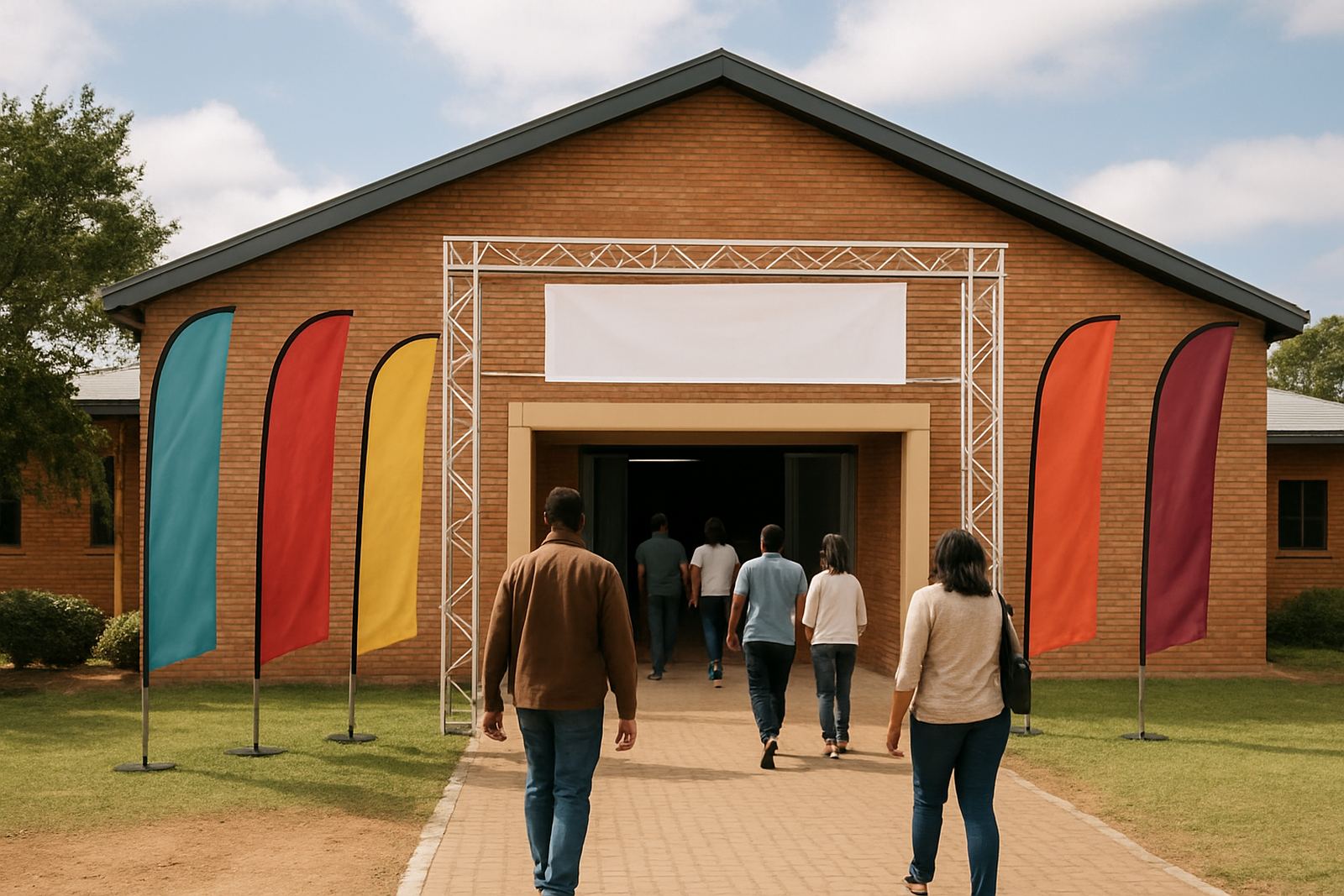
The event site included open ground, hard walls and temporary structures, so we planned for a mix of fixing points rather than one standard format. That meant working with banners for broad visibility, feather flags for approach routes and stage visuals for the main focal point. The setup also had to fit the venue rules, because some areas allowed pegging while others needed weighted bases or tiedown points.
We worked from Hamilton in Bloemfontein and managed the project for Mangaung over a 2 week window from briefing to final installation. The timeline was tight, but the scope was clear enough to keep everything on track.
The brief and the practical limits on site
The organiser wanted the event name seen from the entrance, the seating area and the stage line. They also needed sponsor branding placed neatly without crowding the main message. Visibility mattered most at distance, because people would be arriving on foot and by vehicle, and some signage had to be read in bright sun.
There were three main constraints. First, the venue had uneven wind exposure, especially near the open sides. Second, the surfaces available for fixing were mixed, so not every sign could be mounted the same way. Third, the event setup needed to happen around other suppliers working on lighting, sound and seating, which meant the sign work had to arrive in sequence not all at once.
- Large format banners for entrance and perimeter messaging
- Directional flags for access routes and parking flow
- Stage backdrop visuals sized for a clear audience sightline
- Temporary graphics that could be removed cleanly after the event
We also had to keep the visual hierarchy simple. The main event name had to carry first, then sponsor information, then supporting detail. Too much copy would have made the displays hard to read from a distance, so the layout was stripped back and direct.
Artwork setup and print production choices
Our graphic designer prepared the artwork setup and cleaned up supplied logos where needed. A few images arrived in low resolution, so logo redraws were done to keep edges sharp on the final prints. That mattered on the large stage visuals, where poor artwork would have shown immediately.
For the print side, we used durable banner material with reinforced hems and eyelets for outdoor fixing. Where the display needed a lighter movement effect, the flag material was selected for visibility and motion in the wind. The stage visuals were printed for colour consistency and then laminated where the handling and light exposure called for extra protection. On a project like this, the finish has to suit the location, not just the design.
Specifically, the main banner set included formats up to 3 m x 1 m, with smaller directional pieces sized for closer viewing. The flags were produced on tall poles for distance reading, and the stage visuals were scaled to suit the front and side areas without blocking performer movement. We kept colour matching within the same print batch where possible, so the set held together visually.
- Print production in matched batches for consistent colour
- Graphic lamination on selected pieces for scuff resistance
- Vinyl cutting for clear lettering and sponsor details
- Finishing with hems, eyelets and clean trimmed edges
Installation day and crowd flow
Johan Smit led the on site fitting while the rest of the team coordinated delivery and final placement. The installation took place before the main arrival period, which gave time to check alignment, tighten fixings and adjust any panel that was sitting slightly off square. Small changes on site make a big difference once people start moving through the venue.
The banner positions were set to frame the event without creating visual clutter. Flags were placed where they could catch movement and mark key entry points, and the stage graphics were fixed so they stayed visible from the audience area without interfering with equipment. We also checked the wind load on the taller pieces, because an exposed flag that looks fine at first can become a problem later in the day if it is not set properly.
Load-shedding was part of the planning too, since a dark interval can slow down finishing tasks and affect the order of work. We arranged the sequence so that the most critical visual elements were prioritised first, and the team could keep moving even if power availability changed. That saved time and kept the schedule from slipping.
- Final site survey before fixing points were committed
- Measured placement against audience sightlines
- Weather check and wind allowance on taller units
- Staggered install to suit other event contractors
People behind the project
This kind of event work depends on the right mix of planning and hands on skill. Marius Jacobus van Rensburg oversaw the project direction, while Annelie Botha handled client coordination and timing updates. Lerato Molefe managed production flow, and Thabo Ncgobo handled fabrication details where fittings and finishing had to be exact.
Zanele Dlamini handled the artwork side, especially the sponsor layout and the final readable balance across each format. Kagiso Moeketsi managed the vehicle graphics style standards used on related promotional pieces for the event crew, and Johan made sure the installation sat right on the day. It was a proper team effort, with each role tied to a specific stage of the job.
For event work in Mangaung, this is often what makes the difference. One person can design a sign, but a team has to get it made, packed, delivered and mounted in the right order. That is where Central Signs is strongest, especially when the brief changes slightly just before the work goes out.
What the event achieved and what we would repeat
The finished setup gave the community event a clear identity from the moment people arrived. The main banner line set the tone, the flags helped guide movement, and the stage visuals gave the programme a proper focal point. Sponsors were visible without overpowering the event message, which kept everyone happy and made the space feel organised.
The client was pleased with how quickly the work went up and how well the graphics held through the event period. There was no peeling, sagging or colour fade during the run, and the venue team found the temporary fixings easy to remove after the event. That matters on a public programme, because the job is not finished when the crowd arrives. It ends only when the site can be cleared without damage.
If we were doing the same project again, we would keep the same approach: early site survey, artwork approval before print, and a clear install sequence matched to access and wind conditions. We would also keep spare fixings and an extra check on the taller flags, because Mangaung weather can shift quicker than expected and you do not want to be caught out.
- Clear message hierarchy for fast reading
- Materials chosen for outdoor use and short term handling
- Clean removal after the event with no unnecessary mess
- Room for last minute changes without upsetting the whole plan
From briefing to finish, kept practical
Central Signs treated the Mangaung Hall Event as a full service signage job, not just a print order. That meant taking care of site checks, artwork setup, production, finishing and installation as one chain of work. For community events, that approach saves time and reduces the chance of mistakes.
Our base in Hamilton, Bloemfontein puts us close enough to handle Mangaung and nearby towns without long delays, and that helps when a project needs both speed and attention to detail. Whether the job is for an indoor hall, an outdoor field or a mixed-use venue, the principle is the same. Make it readable, make it weather-ready and make sure it goes up cleanly.
That is what we delivered here, and it is the same way we would handle the next event in Bloemfontein, Botshabelo, Thaba Nchu, Welkom or Kroonstad. No fuss, just signage that does its job.
Key facts
| Client type | Community event organiser |
|---|---|
| Town | Mangaung, Free State |
| Project timeline | 2 weeks from briefing to installation |
| Main products | Banners, flags, stage visuals and directional graphics |
| Material finish | Reinforced hems, eyelets, print lamination on selected pieces |
| Service scope | Site survey, artwork setup, print production, installation and removal support |