What a lightbox sign does for your frontage
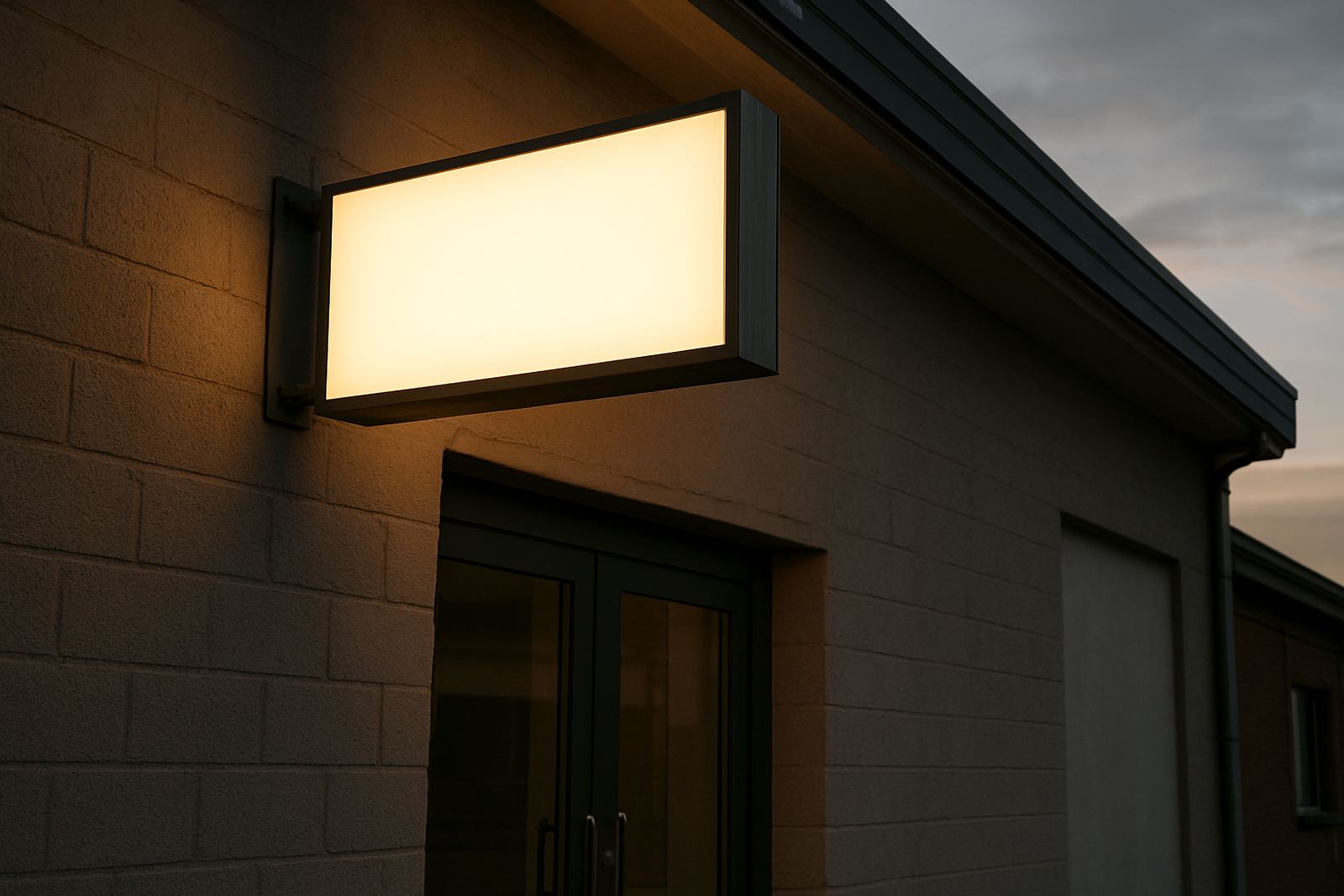
A lightbox sign is an illuminated cabinet with a graphic face that shows your name, logo or message clearly in daylight and at night. It is a practical choice for businesses that need to be seen from the street, from a parking area, or from a distance on busy routes through Mangaung and the Free State.
The cabinet is normally made in a rectangular or custom shape, with internal LED lighting and a face panel that carries the printed or cut graphic. For older premises, a lightbox often gives the cleanest upgrade because it covers tired fascia boards, uneven brickwork or dated painted signage without needing major building work.
- Visible 24 hours a day
- Suitable for fascia mounting, wall mounting or suspended use
- Can carry one logo, multiple panels or directional wording
- Works well for retail, medical, fuel, hospitality and warehousing sites
Sizes, cabinet options and face finishes
Lightboxes are made to suit the site, not the other way round. Small units can start from around 600 x 400 mm for doorway branding, while larger shopfront signs may run to 3 metres or more in length. Depth usually depends on the lighting layout and fixing method, but most outdoor boxes are built with enough depth to spread light evenly and avoid hot spots.
Common options include single-sided wall units, double-sided projecting units, framed fascia boxes and slimline internal displays. The face can be produced as opaque where only cut-out letters light up, or as translucent where the whole panel glows with printed artwork. For businesses close to the N8, or in areas with stronger sun, we usually recommend materials that hold colour well and do not fade quickly.
- Single-sided or double-sided construction
- Square, rectangular or shaped profile
- Printed translucent face, routed acrylic lettering, or combination face
- Aluminium framing, steel support where needed, and weather-sealed edges
If the sign is going onto an older building in Bloemfontein CBD or a windy corner site, we take the mounting surface, wind load and access for servicing into account before fabrication starts.
Where lightbox signs suit best
Lightboxes suit businesses that need strong identification without relying on street lighting. They work well at entrances, above doors, on canopy edges, and on facades where customers arrive after dark or during load-shedding. In Bloemfontein, that matters for evening trade, shift work, and sites that need clear wayfinding for visitors and deliveries.
They are commonly used for pharmacies, takeaways, clothing stores, fuel stops, office parks, churches, sports clubs, medical rooms and warehouse gates. For branches in Botshabelo, Thaba Nchu, Welkom or Kroonstad, a lightbox can help tie several sites together with the same look while still allowing each premises to show its own trading name and contact details.
- Shopfronts and mall entrances
- Road-facing facades and pylon add-ons
- Reception areas and interior brand walls
- Directional signs, gate signs and parking notices
Because the unit glows from within, the message stays readable in dust, rain and evening traffic, which is useful for rural stops and busy urban roads alike.
Installation, power and access needs
Installation must be planned properly so the sign is safe, level and easy to maintain. Most lightboxes require a suitable wall, steel frame or bracket system, plus an electrical feed from a switched circuit. If the site has load-shedding or unstable power, we can discuss how the sign should behave when supply is interrupted, and whether the client wants it linked to existing backup power on site.
For outdoor work, we allow for weatherproof cabling, concealed wiring where possible, and access for future lamp or driver replacement. On higher facades, a scaffold, boom lift or other access arrangement may be needed. We also check for obstacles like cornices, gutters, security bars and uneven plaster before fixing anything to the wall.
- Requires a suitable 220V electrical supply unless otherwise specified
- Outdoor units need weatherproof seals and correct drainage points
- Mounting points must suit the wall type, brick, steel, cladding or concrete
- Access should be planned for cleaning and future servicing
Where municipal or landlord approval is needed, we can work from the agreed dimensions and help ensure the sign layout suits the property rules.
How to keep the sign bright and tidy
A lightbox sign needs regular attention, but not complicated maintenance. Dust, insects and road grime can dull the face over time, especially in windy or semi-industrial areas. Cleaning the outer face with a soft cloth and mild soap keeps it presentable. Harsh solvents should be avoided because they can scratch acrylic or lift printed film.
The internal lighting should be checked if brightness drops, if a section flickers, or if the sign no longer lights evenly. LED components last well, but drivers and electrical connections can still wear out, particularly where temperature changes, vibration, or moisture are present. At the coast this is a bigger issue, but even in Bloemfontein a neglected sign can fail early if water gets into the cabinet.
- Wipe the face regularly to remove dust and bird marks
- Check for loose fixings after strong wind or storm damage
- Look out for dim areas, flicker or colour shift
- Book maintenance before the sign becomes hard to read
We also handle refurbishment on existing boxes, including new faces, updated graphics, re-lamping and debranding when a tenant changes or a branch is rebranded.
What to check before you order one
Good results start with accurate details. Before quoting or fabrication, it helps to know where the sign will sit, how far it must be seen from, and whether the branding should match other branches. If you already have a logo, we can work from supplied artwork. If not, we can redraw artwork for production so the cuts, curves and spacing are correct before printing or fabrication begins.
For a lightbox order, please check the following:
- Exact sign size or the available wall space in millimetres
- Mounting surface and whether there is existing wiring on site
- Daytime and night-time visibility needs
- Whether the sign should be one-sided or double-sided
- Brand colours, font style and logo files if available
- Any building rules, landlord requirements or municipal approvals
We work from Hamilton in Bloemfontein and cover the wider region including Mangaung, Botshabelo, Thaba Nchu, Welkom and Kroonstad. If you need a sign that holds up to daily use and still looks sharp after dark, a properly made lightbox is a practical choice.
Why local fabrication matters for Free State sites
Local fabrication helps with turnaround, site measuring and after-sales support. It also means the sign can be built with the conditions of the Free State in mind, from strong sun and dust to winter cold and irregular site access. A properly made lightbox should suit the wall, the wiring and the business hours, not just the artwork.
At Central Signs, the team handles site surveys, artwork setup, fabrication, installation and follow-up servicing under one roof. That makes it easier to keep the final result consistent from the first measure to the last screw, and to return later if the sign needs a clean-up or repair.
- Measured for the actual site
- Built for local weather and operating conditions
- Installed by an experienced sign team
- Supported with refurbishment and maintenance visits
Key facts
| Product type | Illuminated lightbox sign for indoor or outdoor use |
|---|---|
| Typical sizes | From about 600 x 400 mm up to 3 m+ and custom sizes |
| Lighting | Internal LED lighting with even face illumination |
| Construction | Aluminium or steel frame with acrylic or translucent face |
| Mounting | Wall, fascia, bracket or suspended installation |
| Power needs | 220V electrical supply, weatherproof wiring and access for servicing |